


THE POISON OF POWER, THE PRICE OF SOVEREIGNTY, AND THE WORLD'S SYSTEM ERROR

Ayhan KIZILTAN, ben@ayhankiziltan.com.tr, Mersin, Türkiye, 28 March 2026
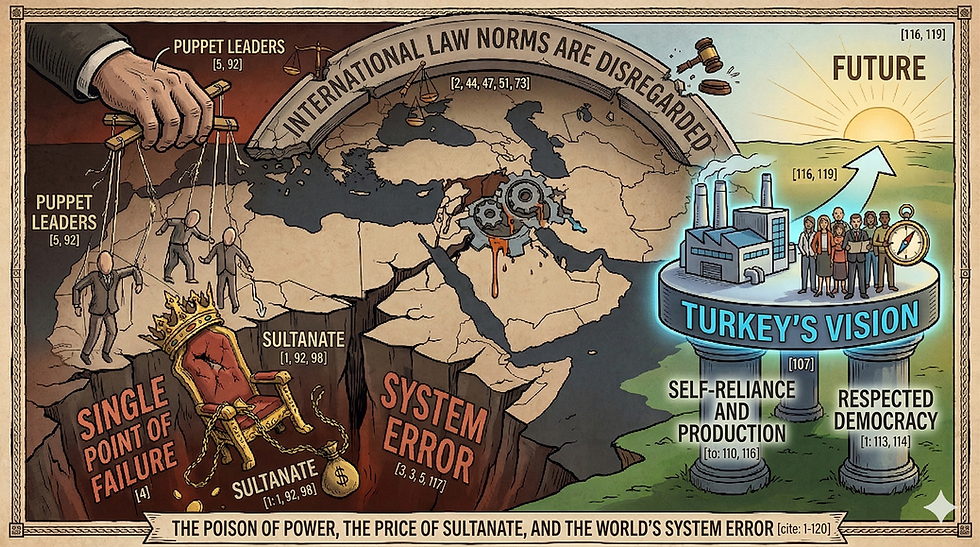
Today is March 28, 2026. The smoke rising in the Middle East comes from the debris of not only buildings but also the international legal norms that humanity has built with immense effort.
This massive tension on the USA-Israel-Iran axis is actually the manifestation of a "global system error" that has been woven stitch by stitch for decades. From the perspective of a mechanical engineer, I see that the world today is experiencing a "Single Point of Failure" crisis. Entrusting global security and the fate of billions of people to the initiative of just a few leaders, or the "power lobbies" that pull their strings like puppets, is the greatest proof of systemic collapse.
Economic Impacts of War: "The Greatest Trade Rupture in 80 Years"
International sources describe this process as a supply chain crisis deeper than the pandemic.
On a Global Scale:
Energy Shock: Brent crude prices surged by more than 40% compared to pre-war levels, exceeding $115 per barrel.
In Europe, natural gas prices doubled in just three weeks.
Logistics Collapse: The simultaneous destabilization of Hormuz and the Red Sea forced global trade to divert toward the Cape of Good Hope.
This situation increased container costs by 300% and extended delivery times by 2-3 weeks.
Growth Loss: The WTO (World Trade Organization) announced that if the war continues this way, a loss of at least 0.3% to 1% in 2026 global GDP growth is expected.
Specifically for Türkiye:
Current Account Deficit Pressure: Türkiye’s energy import bill is under great risk.
Economists warn that a permanent rise in energy prices could push the current account deficit-to-GDP ratio above 3%.
Cost of Living and Inflation: The process of price increases, which was already unstoppable before the war, accelerated further due to fuel prices following the start of the conflict.
Alternative Route Role: The blockage of sea routes on the East-West axis has made Türkiye’s land and rail connections (the Middle Corridor) a vital alternative.
Strategic Goals of the USA and Israel
For the parties involved, this war is not just a military operation but an attempt to determine the next 50 years of the region.
Israel’s Goal: For Israel, this war is described as an "existential cleansing". The primary goal is to physically destroy Iran’s nuclear capacity and logistically paralyze the "Axis of Resistance" (Hezbollah, Houthis, etc.) stretching from Lebanon to Yemen. The Israeli administration has shifted from a strategy of "mowing the grass" to "high-level leadership elimination" aimed at directly shaking the regime. The ultimate goal is to bring the Middle East to its knees and expand its territory by bringing the USA to its side.
The USA’s Goal: Washington aims to permanently disable Iran’s ballistic missile and drone production infrastructure. Under the Trump administration, the ultimate goal is to force Iran into "unconditional surrender," breaking Iranian guardianship over global energy routes (Strait of Hormuz) and establishing a new security architecture in the region. Essentially, the primary goal is to seize all resources in this geography.
Israel and the "Regional Security Paradox"
In foreign sources, Israel's military doctrine in the region is often analyzed as "survival instinct turning into aggression".
Nuclear Non-Transparency: Israel’s nuclear weapons—unacknowledged but known by everyone—render the regional power balance asymmetric in Israel's favor. This serves as the primary fuel for countries like Iran seeking "nuclear deterrence".
Humanitarian Devastation and Trust Crisis: Operations conducted without regard for civilians, children, or the elderly are rapidly eroding Israel's claim of "self-defense" in the eyes of the international community. The scale of civilian casualties in this 2026 operation is interpreted as a "historical collapse of trust in Israel" not only among regional peoples but also within NGOs in Western capitals.
Who Can Trust? The Risk of the Future
The answers to these questions explain why the world is evolving into a "Multi-Polar" structure:
Fear Replaces Trust: States no longer trust international law or the protection of a major power; they rely on their own defense industries and regional alliances.
Moral Crisis: A power (USA or Israel) winning militarily does not mean it has won morally or politically. The greatest loss of this 2026 war has been the belief in the concept of "universal human rights".
"Authority" Debate and International Law Analysis
The USA’s intervention from across the ocean causes a serious legitimacy crisis in international law:
UN Charter Article 51: The USA and Israel defend the attacks under "preemptive self-defense". They present Iran's nearing of nuclear weapon capability and the "imminent threat" to US assets in the region as legal justification.
Legal Vacuum: Critical foreign sources (Guardian, Just Security) emphasize that this operation, launched without UN Security Council approval, is a "violation of sovereignty". It is stated that the concept of "imminent threat" is being expanded and used as it was during the 2003 invasion of Iraq, weakening the international legal order.
Jurisdiction Issue: The USA sees ensuring the security of its regional allies (Israel and Gulf countries) as a "global gendarmerie" mission. However, jurists remind that for "collective self-defense," there must be an explicit call for help from the victim state, whereas this operation began largely unilaterally.
Unfortunately, law has fallen behind power dynamics. Two fundamental rules are being violated in the current conflicts:
Principle of Proportionality: A response to a military threat must be at a level to neutralize that threat. Bombing civilian infrastructure (hospitals, water facilities) directly violates this principle and falls under "war crimes".
Principle of Distinction: The necessity to distinguish between combatants and civilians. Despite the "precision strike" capability of modern munitions, the high rate of civilian deaths shows this principle is being ignored under the label of "collateral damage".
The Position of Russia and China: "Strategic Opportunism"
While Beijing and Moscow avoid direct involvement in the war, they seek to turn this chaos to their advantage:
Russia condemns the attacks rhetorically but does not send military aid. Oil prices rising above $110 eases its budget. It diverts the West's attention away from the Ukrainian front.
China calls for "calm and diplomacy" while continuing to buy Iranian oil by bypassing sanctions. Its energy supply security is at risk. It finds an opportunity to reduce pressure over Taiwan by disrupting the USA's "Asia-Pacific" focus.
Russia and China do not want Iran to collapse completely, as that would mean the Middle East becoming an American lake. However, they refrain from risking their own military forces for Iran. They tend to manage this situation as "controlled instability".
"Shadow Governance" of Power Lobbies and Puppet Leadership Risk
More dangerous than a leader being malicious is them being inconsistent and open to manipulation. In the modern world, "power lobbies" (arms lobbies, energy giants, financial cartels) make strategic decisions based on short-term profit maximization rather than rational state reasoning.
Asymmetric Decisions: If a president is under the influence of defense industry lobbies, turning toward policies that fuel conflict instead of peaceful solutions becomes a "commercial necessity".
Loss of Accountability: Since these lobbies are not elected, they cannot be held responsible for the human costs (civilian deaths, destroyed cities) of their decisions.
Piercing the Institutional Shield The claim of democratic systems is that "institutions are superior to individuals." However, as seen in recent years, powerful lobbies and populist waves can bypass these institutional structures (Foreign Ministry bureaucracy, judiciary, oversight mechanisms). A leader commanding nuclear codes or a massive army being able to take operational decisions as easily as sending a "tweet"—without passing through an institutional filter—creates an unpredictability nightmare for the whole world. When power is concentrated in one hand, international law ceases to be a "tool of justice" and becomes a "cover" that the strong fits to their own actions.
Social and Humanitarian "Side Effects"
The massacres carried out without regard for "civilians, the elderly, or children" are the bitterest result of this uncontrolled power.
Erosion of Trust: No one looks at a superpower or its ally as a "bringer of justice" anymore. This creates a global "moral vacuum".
Radicalization: Arbitrary bombings and unjust occupations do not just cause physical destruction; they also sow seeds of irreparable "anger" and "radicalization" in future generations. This ultimately creates a greater security threat for the countries holding that "power" in the long run.
The USA's Dark Algorithm: The Dictator Production Line
The USA's foreign policy has a dark algorithm that has remained unchanged for years, functioning like a factory setting. The operating principle is this: first, install a "useful" dictator who is easy to manage at the head of the country you intend to exploit. Through him, quietly exploit that country's underground and surface resources. Subject this installed dictator to "power poisoning" with the unlimited means you provide, so he becomes detached from his people, turns authoritarian, and begins to oppress his own citizens.
When the dictator outlives his usefulness or becomes uncontrollable, the USA steps onto the stage wearing a "savior" mask. The same USA sends troops under the lie of "bringing democracy to your country," and overthrows that dictator by burning and destroying. Libya, Iraq, and Syria are the freshest and most painful examples; now they are trying this in Iran.
I ask you: which oppressed people has the USA truly developed to date? In which geography it entered has it established peace and prosperity?. We all know the answer: None! All that remains are ruins with displaced resources.
The Desperation of "Long Live My King" and the Handover of Resources
The greatest accomplices of this exploitative order in the region are the dictators who give themselves titles like king or emir. These individuals have surrendered unconditionally to the USA and Israel just to protect their own sultanates and palaces.
The USA has been exploiting the resources of these countries for years; in return, it provides "throne insurance" for these dictators. Peoples are deliberately left helpless and ignorant, pushed into religious and sectarian conflicts. Because a questioning public is the greatest threat to this "handover order". While their country's wealth flows to foreign powers, these fake sultanates that make their people say "Long live my king, long live my emir" are actually stealing the future of a geography. For these regimes, it is not national interest but "palace interest" that comes before everything else.
Europe’s Existential Fear: "Are We Next?"
However, this recklessness is now causing deep concern not only in the Middle East but also in Europe. Europeans, who lived in comfortable prosperity for years by entrusting their security to the USA’s nuclear umbrella, have finally woken up after what happened to Iran and the arbitrary wars in the region.
They have realized they can no longer trust a USA led by an unpredictable leader like Trump, who is easily directed by power lobbies. Having seen how countries they previously ignored are being swallowed by powers under the mask of an ally, the following question now echoes in European capitals: "Could they do the same to us tomorrow if our interests clash?". Indeed, what Trump has said about Europe since the day he was elected is evident. This fear could turn the European Union into a "key actor" poised to disrupt this unjust "new world order" that the USA and Israel want to establish.
A Visionary Exit for Türkiye: The Mersin and Çukurova Line
So, what should we do in this massive turbulence? The only way for Türkiye to protect itself from this spiral of exploitation and war is to arm itself with strategic intelligence and a democratic shield.
Spreading the Burden of Marmara to Anatolia: Confining our industrial and logistical power only to Marmara is a major security vulnerability. Transferring this load to safe ports and the Anatolian interior—especially to regions with strong potential like Mersin-Çukurova—is not a preference, but a condition for national survival.
Becoming a Self-Sufficient Country Again: We must be a country that is self-sufficient in agriculture, industry, technology, and defense, and capable of offering its production to the world.
Education and Culture Mobilization: We must create an education system that raises our people to—and above—the education and culture levels of the world's most developed countries in every field.
Ensuring Internal Unity: As MHP leader Bahçeli stated, we must ensure internal unity, but without regarding political concerns and interests.
Democracy is the Greatest Guarantee: The real guarantee that will bind a visionary investor and peace to our country is not missile shields, but the unshakable democratic culture of our Republic. A country where democracy and law prevail is the most resilient against scenarios dictated from the outside.
In conclusion; the future will belong not to those who sell their people and resources to protect their sultanate, but to those who claim their own inherent power, their own people, and their own freedom. This world order that gives a "single point of failure" will eventually break. Our duty is to have built a Türkiye that is both economically and democratically robust when that day arrives.
The future will belong to those who keep justice and humanity alive.
Goodbye, until we meet in my next article…


Comments